Every engineering team eventually inherits the "Untouchable Service."
It was written eight years ago in a language nobody on the current team prefers. The original authors left three funding rounds back. There are no automated integration tests, the deployment process involves a bash script named deploy_final_v2.sh, and the database contains 400 tables with circular foreign keys and stored procedures containing core business logic.
Yet it processes $40 million of transactional volume a year.
Inevitably, an executive team gets tired of hearing that simple feature requests will take four months. A meeting is called. A senior engineer stands at the whiteboard, draws a clean microservices diagram, and declares:
"We need to rewrite this from scratch."
It sounds courageous. It sounds clean. It is almost always a catastrophic mistake. If your company wants to modernize legacy systems without rewrite disasters, you need an incremental operational strategy.
What is the Strangler Fig pattern in legacy modernization?
The Strangler Fig pattern is an architectural modernization strategy where new services are built incrementally around the perimeter of an existing legacy monolith. By placing an interception proxy in front of legacy services, engineering teams can route individual workflows to new platforms without a high-risk Big Bang cutover.
The Big Bang Trap: Competing With a Moving Target
Total system rewrites fail for a predictable structural reason: the legacy system is not a static specification; it is an accumulated history of resolved business edge cases.
When an application runs in production for seven years, every bizarre conditional block and obscure database trigger was added because reality violated an assumption. A customer in Germany had an edge-case tax ID. A warehouse scanner dropped connection every Tuesday at 3 AM. A payment provider intermittently omitted transaction timestamps.
When you decide to rewrite from scratch, you don't just rewrite the features listed in your product documentation. You rewrite seven years of undocumented battle scars.
Worse, while your rewrite team spends 18 months building the "new foundation," the business cannot freeze operations. The market demands new features, compliance rules change, and new customer types sign contracts.
The legacy team keeps modifying the old system to keep revenue coming in.
Now the rewrite team is chasing a moving target. By month twelve, the new system is already missing 30% of the features the old system gained over the past year. Deadlines slip. Morale tanks. Leadership panics.
Eventually, companies compromise: they force an early cutover with a half-finished system, experience weeks of Sev-1 outages, and create a "new" system that is just as fragile as the one they set out to replace.
The Strangler Fig: Incremental Extraction Over Replacement
In 2004, Martin Fowler named the alternative after the strangler fig tree, which seeds in the upper branches of an existing tree, grows vines downward to the soil, and gradually replaces the host tree from the outside in.
In software architecture, this means you never rewrite a legacy monolith all at once. You construct new capabilities around the edges of the existing system, intercept traffic, and progressively siphon away operational responsibility until the legacy core can be decommissioned without incident.
Most teams understand the concept of a Strangler Fig. Where they fail is in execution: they attempt to extract code before they isolate data.
Here is the practical, step-by-step framework for executing a legacy modernization that actually finishes.
Step 1: Map the Blast Radius Before Touching Code
Before refactoring a single function, you must map the invisible coupling inside the legacy system.
In modern distributed systems, services talk over clear network APIs. In legacy monoliths, services communicate through shared state:
- Direct database queries across domain boundaries.
- Database triggers that silently update secondary tables.
- Nightly cron jobs that mutate records while the application runs.
- In-memory session caches that assume a single execution host.
Take one specific operational workflow—for example, Invoice Generation. Trace every query executed during that workflow.
If the invoicing logic reads from the user table, updates an inventory ledger, and fires a stored procedure in an accounting schema, you cannot simply extract the invoicing code. You have to decouple its data dependencies first.
If you cannot cleanly describe what data a module reads and writes without scanning 50 unrelated tables, the module is not ready to be extracted.
Step 2: Establish the Interception Layer
You cannot safely extract functionality if clients are hardcoded to hit legacy server endpoints.
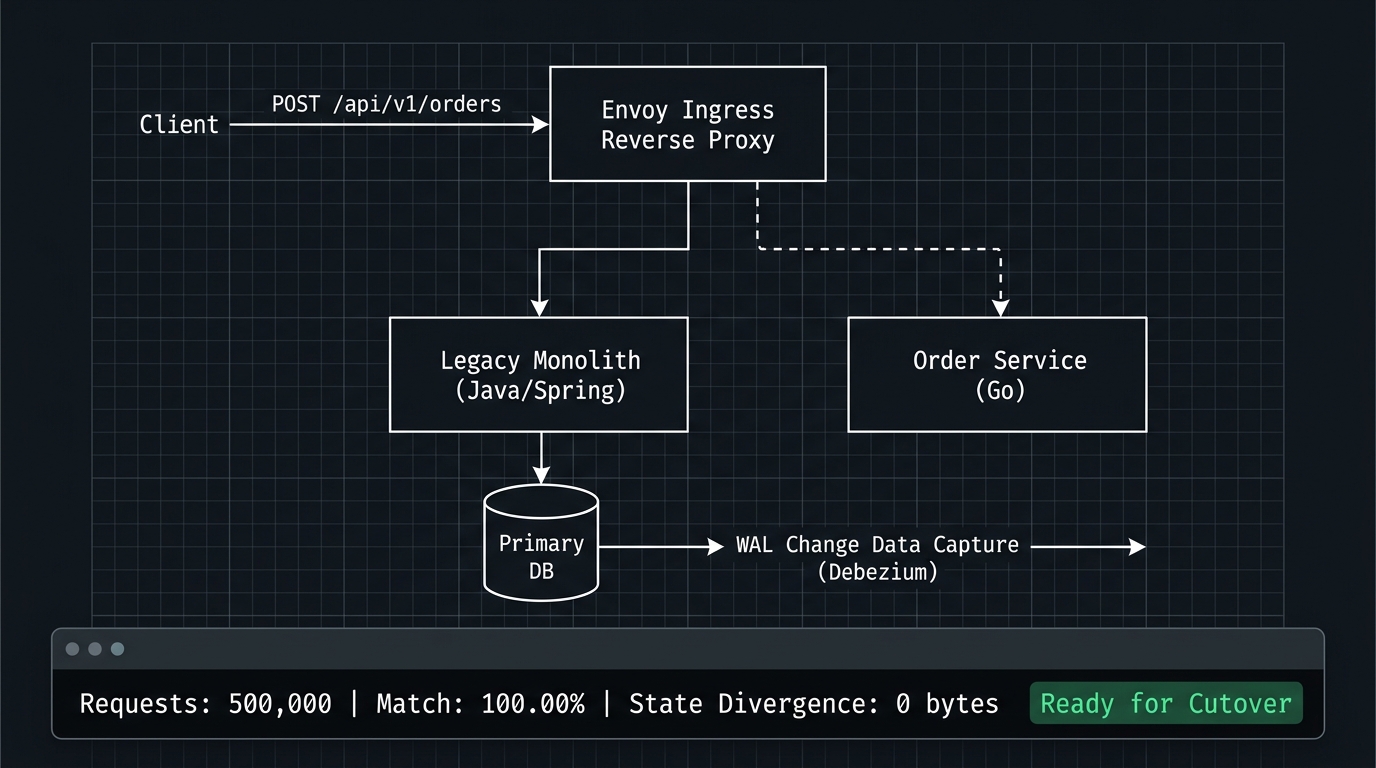
The first production deployment of any modernization project should be an interception gateway (such as an Envoy proxy, Cloudflare Worker, or a lightweight API gateway) placed directly in front of the legacy system.
Initially, this proxy does nothing except forward 100% of traffic to the legacy monolith. It adds zero business logic.
Its sole purpose is architectural leverage: it gives your engineering team the ability to reroute individual HTTP paths, specific customer IDs, or percentage-based traffic splits without requesting client-side changes or mobile app updates.
Step 3: Capture Data at the Log Layer, Not the App Layer
The hardest problem in legacy modernization is keeping data synchronized between the old database and the new service.
The naive approach is dual-writing from application code:
# The Fragile Anti-Pattern: Application-Level Dual Writing
def update_customer_balance(customer_id, new_balance):
    # Step 1: Write to legacy DB
    legacy_db.execute("UPDATE customers SET balance = %s WHERE id = %s", (new_balance, customer_id))

    # Step 2: Attempt write to new platform
    try:
        new_platform_api.update_balance(customer_id, new_balance)
    except Exception as e:
        # What do you do here? Roll back legacy? Log and ignore?
        # Now your systems are out of sync.
        logger.error(f"Failed sync: {e}")
Application-level dual writing is a recipe for state drift. If the network drops between Step 1 and Step 2, or if the server crashes mid-execution, your databases diverge permanently.
Instead of writing twice from code, tap the database's internal transaction log using Change Data Capture (CDC) tools like Debezium or cloud-native replication streams.
Because CDC reads directly from the write-ahead log (WAL), it introduces zero performance overhead to the legacy application. More importantly, it guarantees that every committed transaction in the legacy system is converted into a durable, ordered event stream that your new system can consume at its own pace.
Step 4: Run in Shadow Mode Before Cutover
Never cut traffic over to a new system based solely on unit tests. Real enterprise systems run on real-world edge cases.
Use traffic shadowing (dark launching). Configure your interception gateway to duplicate incoming requests. Send the live request to the legacy system and return its response to the customer. Simultaneously, send an identical copy of the payload asynchronously to the newly extracted service.
Build a comparison tool to diff the outputs:
- Did the new service calculate the exact same tax amount down to the penny?
- Did it format timestamps identically?
- Did it handle the missing optional field without throwing a
500 Internal Error?
Run in shadow mode for two weeks. When your diff tool reports 0.00% divergence across 500,000 real-world production transactions, you aren't guessing whether the new system works. You have mathematical proof.
Step 5: Cut Over and Decommission Cleanly
Once shadow mode confirms zero divergence, flip the gateway routing rule. Direct live production traffic to the new service.
Keep the CDC stream running in reverse if possible (replicating from the new service back to the legacy database) for 72 hours as a failsafe rollback parachute.
Once stability is verified, delete the legacy code paths and drop the deprecated database columns. Modernization isn't finished when the new system is turned on; it is finished when the old code is permanently deleted.
Modernization is an Operational Discipline
You do not need an 18-month code freeze or a multimillion-dollar rewrite project to rid your business of fragile legacy systems.
You need an architectural strategy that respects production reality:
- Isolate boundaries before touching business logic.
- Intercept traffic at the edge.
- Synchronize state using transaction logs rather than fragile dual writes.
- Prove parity in shadow mode using live production volume.
Modern engineering isn't about writing code on a blank slate. It is about steering operational systems through continuous evolution without losing stability or velocity along the way.
To understand why systems become tightly coupled in the first place, read our deep-dive on why business systems become fragmented as organizations grow. To rigorously audit your stack before making architectural investments, use our practical framework for evaluating an existing system.
Planning a System Modernization?
If your team is facing a high-risk legacy migration, brittle database dependencies, or an operational system that has become too fragile to change, let's talk through the architecture.
Pluggedspace builds sovereign deployable platforms and provides Forward Deployed Engineering teams to modernize critical legacy systems without operational downtime.
Discuss your migration boundaries and risk mitigation with our team →